
Torrevieja for buyers: areas, prices and what living there is like
Who this is for: For buyers choosing a town on the Costa Blanca who want to know how Torrevieja works from the inside: who lives there, how the areas differ and what homes cost.

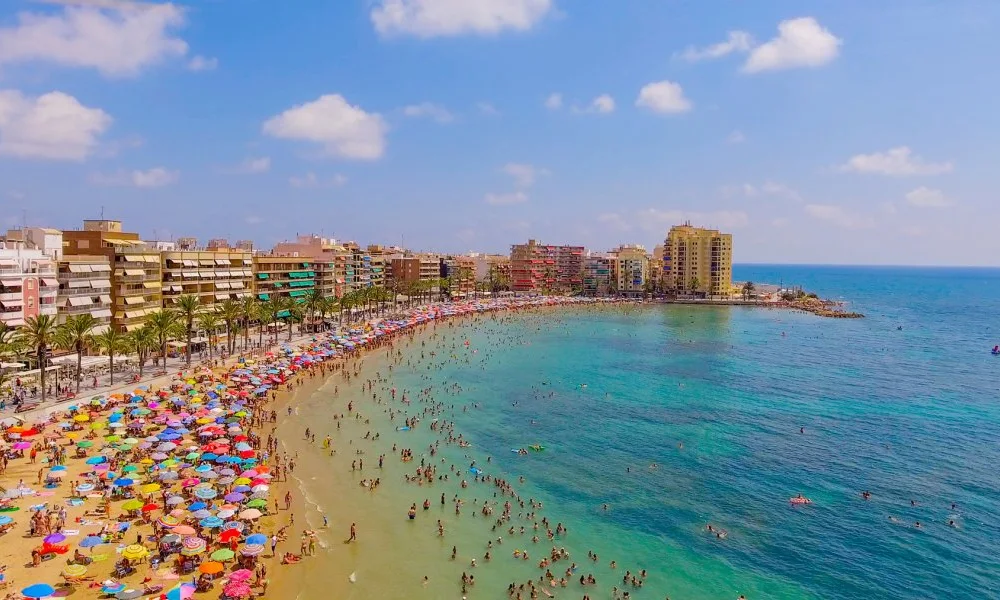
Torrevieja is one of the most looked-at towns on the Costa Blanca, and the one with the most myths attached: from "it's all pensioners" to "the World Health Organization named it the healthiest place on earth".
Here is what it is actually like. No sales pitch: some of it you will like, some of it you may not.
In short
Torrevieja is one of the most affordable towns on the Costa Blanca: €2,561 per m² on average in September 2026, from €2,158 in the centre to €3,240 in Punta Prima. Winters are mild, around 17 °C by day, and six beaches hold a Blue Flag in 2026. More than half the residents are foreign, from 120 nationalities, so English is heard everywhere. The trade-off: a very international town, crowded in summer and quiet in winter. Choose an area, not just "Torrevieja": the centre, the coast and the inland urbanisations are three different lives.
Who lives here
One number explains most of Torrevieja.
The town has 113,453 registered residents (municipal register, May 2026). More than 62,000 of them are foreign nationals: 54.7%. There are more foreigners in Torrevieja than Spaniards, from 120 nationalities.
The largest communities are Ukrainians (10,787), Colombians (5,892), Russians (5,834), British (4,671) and Moroccans (3,743). These are people registered as living in the town; many more British and Scandinavian owners spend part of the year here without registering.
In practice: you will hear English in shops, bars and on the beach, and plenty of services work in English, from dentists to car repairs and estate agents. Settling in is easy.
The other side of the same coin: Spanish comes slower here than in a town where you are the only foreigner. Some people live here for years on a hundred words. Whether that suits you is your call.
Climate
From the Alicante weather station, the nearest one run by AEMET, Spain's official weather service: the average daytime high is 17.0 °C in January, 17.6 °C in February and 17.7 °C in December. In summer it is 30.3 °C in July and 30.8 °C in August. The year brings 2,851 hours of sunshine and only 311 mm of rain.
In plain terms: in winter it is about seventeen degrees by day, jumper weather for a walk. Summer is hot, but easier by the sea than inland. Rain is rare and brief, usually autumn downpours.
Notice that December, January and February have almost the same daytime temperature. That is the mild Mediterranean winter people come for.
About the WHO claim
Property adverts keep repeating that "the World Health Organization named Torrevieja one of the healthiest places to live on the planet", sometimes citing a report from the 1980s.
We looked for the original and did not find it: no WHO document, no reference to one. The phrase travels from advert to advert without any source.
What is real: a dry climate, a lot of sunshine, the sea and two salt lagoons next door. Doctors do often recommend this kind of climate for breathing and joint problems. But that is common sense and medical practice, not a ruling by an international body. We prefer to say it as it is.
The pink lagoon and the salt lakes
The town's main natural sight is the Lagunas de La Mata y Torrevieja natural park. It spreads across four municipalities: Torrevieja, Guardamar del Segura, Los Montesinos and Rojales.
One of the two lagoons is pink. The town hall's official site explains why: a bacterium releases a pink pigment when the salt concentration reaches around 350 grams per litre. It is the only such case in Spain.
Salt has been harvested here for centuries; the town grew out of it. For residents the park is a place to walk and run; for visitors, a place to take photos.
Beaches
In 2026, six Torrevieja beaches kept their Blue Flag: Cala Piteras, Los Náufragos, El Cura, Los Locos, Cabo Cervera and La Mata Sur.
The Blue Flag is an international award for water quality, safety, access and environmental management. Six for one town is a good record.
The beaches differ in character. The town beaches, El Cura and Los Locos, are a walk from the centre and busy in summer. La Mata to the north is a long sandy beach next to the natural park, with more room.
Four different Torrevieja
The town stretches along the coast, and its homes vary enormously. Broadly, there are four kinds of area.
The centre. Dense, with the promenade, the port, shops and restaurants within walking distance. Mostly older buildings from the 1970s and 1980s. It is the cheapest part of town: €2,158 per m² in September 2026, according to idealista. For people who want to live without a car and like town life.
The north coast: La Mata and Cabo Cervera. A beach, the natural park next door, lower and more spacious buildings. Quieter than the centre, but you will more often need a car for shops and doctors. La Mata averages €2,932 per m².
The south coast: Punta Prima and around. Newer developments, closer to Orihuela Costa. The most expensive part of town: €3,240 per m² in Punta Prima, half as much again as the centre, in the same town. You pay for being close to the sea and for modern homes.
The inland urbanisations: La Siesta, El Chaparral, Los Balcones and others. Detached houses, townhouses, bungalows with small gardens and their own pools. Ten to twenty minutes by car to the sea. More space for the money, but hard to manage without a car. La Siesta and its neighbours average €2,380 per m²; Los Balcones, €2,891.
What homes cost
The average price across Torrevieja in September 2026 was €2,561 per m², up 9.3% in a year.
For comparison, in the same month: Alicante €2,743, Guardamar €2,643, Orihuela Costa €3,058, Benidorm €3,824. Among the towns we cover, only those on the Mar Menor are cheaper: San Pedro del Pinatar was about €2,000 per m² in August 2026. So Torrevieja is one of the most affordable towns on the Costa Blanca.
Within the town, the range runs from €2,158 in the centre to €3,240 in Punta Prima.
Current listings with prices are on our page property in Torrevieja.
Hospitals, schools and shops
Healthcare. The town has a public hospital, the Hospital Universitario de Torrevieja, part of the Valencian Community's health service, plus a network of private clinics. Many doctors see patients in English.
Schools. There are Spanish state schools and several international schools in the area. State school is free, including for foreign children living here legally. Younger children usually pick up Spanish within a year or eighteen months; it is harder at secondary age.
Shops. All the big chains are here: Mercadona, Consum, Lidl, Carrefour. There are also smaller shops catering to the town's many foreign communities.
Getting there
Alicante-Elche airport is 48 km away, 35–40 minutes by car. It is the nearest international airport, with flights to most of Europe, including several UK and Irish airports.
There is a bus network in town, but it is resort-grade: fine for reaching nearby towns, not for a daily commute. Most residents have a car.
Summer and winter: two different towns
Worth knowing in advance.
In summer Torrevieja is packed. With holidaymakers the population grows several times over, the promenade is crowded, parking in the centre is hard to find and the popular areas are noisy until late.
In winter the town empties. Some cafés and shops close until spring, and in some developments you may be one of very few residents. Some people love it: quiet, empty beaches, warm sun. Others find it lonely.
The usual advice: come and look in February. Every resort looks good in summer.
Who Torrevieja suits
It suits you if you want a mild winter, the sea nearby and an easy international community from day one. If you want an affordable price per metre for the coast. If you are buying for holidays or for retirement.
It may not suit you if you want "real Spain" and full immersion in the language: it is too international for that. If you do not want a car but are looking at the urbanisations. If the summer crowds would annoy you and the flat you like is in the centre.
We live and work in the area. Tell us what matters to you, whether quiet, walking distance, a school nearby or a sea view, and we will suggest the area first, then the property. How the purchase itself works is in how to buy property in Spain, and what you will pay each year in running costs of a home in Spain.